How to read one newspaper article like an MBA student
20 October 2026 · 8 min read
Dr. Deepak Maun, Programme Director for the MBA at K.R. Mangalam University, PhD in Innovations and Management in Education from IIM Ahmedabad.
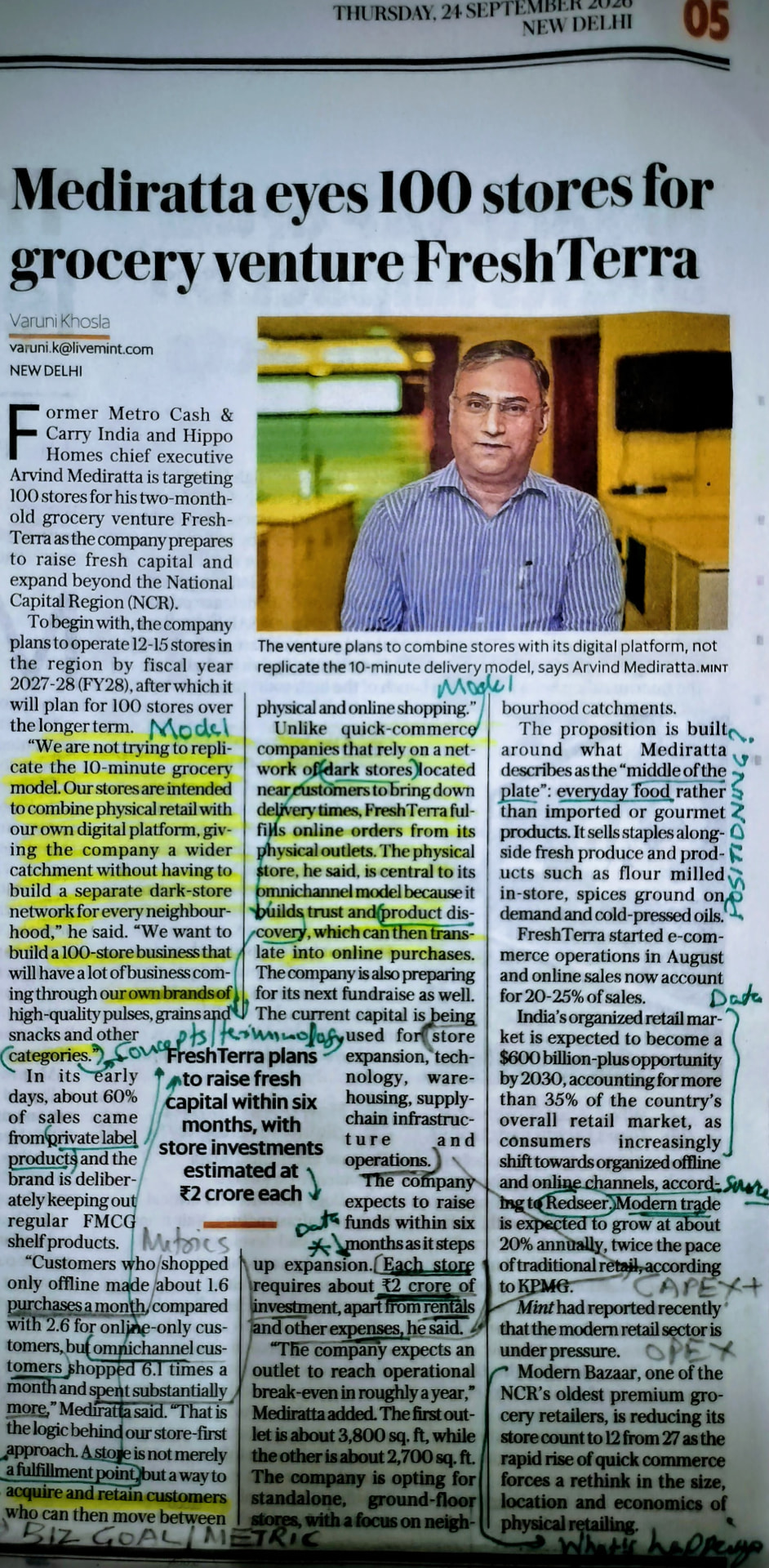
The newspaper on my desk this morning was three weeks old. I read one article in it, pen in hand, for about 30 minutes, and I took away as much as I would have on the day it was printed.
We keep telling MBA students to read the newspaper. Yet we almost never tell them which parts to read, or how. So most students chase the latest edition, feel guilty about the pile they have not finished, and give up within a month.
Here is what I teach instead. Unless you are preparing for the UPSC, where yesterday's events are examinable, or your job runs on the day's news (a commodity trader's does), the freshness of the paper barely matters. A CEO's strategy interview teaches the same thing three weeks later as it did the morning it was published. What expires is a small slice. Share prices, quarterly results, company specific data. Everything else, a company's distribution model, the economics of a sector, the way a business actually makes money, stays in place for months and often longer. The date on the masthead barely matters. What matters is how closely you read one article.
You do not need today's newspaper, and you do not need all of it
Very few people actually need the morning's paper. Someone sitting the UPSC, where yesterday's events are examinable. A politician or senior bureaucrat whose week turns on the news cycle. A commodity trader waiting for the one headline that moves a position. For an MBA student, almost none of the news worth reading expires that fast.
There is one exception. If a large event has hit the sector since the article was published (a war, a regulation, a crash), the strategy in it may have shifted. In that case the event itself is what you need to know, and the question you read with is what the company did about it. Else, an old article is as good as a new one, and often better, because you can read it next to what the same company did next.
So you do not read the whole paper and you do not chase the latest edition. You skim the headlines, read what interests you, and read one article closely. What should that one article be? Any company or sector analysis. A policy piece. A geopolitical or environmental crisis that is hitting (or about to hit) local or global supply chains. Pick one that interests you, ideally in a sector you are targeting for a job or a startup (though a wide reading interest helps, at least in the beginning).
How much time? If I had to teach it with one rule, it would be this. On a bad day, 30 minutes and one article. Itna toh karna hi hai (that much you have to do), even on your worst day. On a good day, 60 to 90 minutes, 2-3 articles, and a look back at your old notes.
Three passes over one article, and most people skip the second
The method is three passes over one article, and the pass most people skip is the second.
Step 1. Read with a pen and a highlighter. Mark what is worth keeping, circle the company names, put a question mark where a claim looks thin. If you are reading online, use an annotation tool like Glasp.
Step 2. Put the paper down. Before you write a word, make yourself recall what you already knew about this company and this sector, and how this article updates that understanding. This is the step everyone skips, and it is the one that makes the reading stick. Forcing that recall is what turns an article into something you still hold 6 months later. It updates your mental models.
Step 3. Now write a few notes in your own words, in a digital notebook you can search and add to for years. Notion, Obsidian, or even Google Docs will do. The tool matters far less than the habit of putting the idea down as your own sentence.
I have written separately about the Personal Knowledge Management System this builds into over two years. This article is that system run on a single piece.
What one article about a grocery chain actually teaches
The clipping at the top of this piece is a Mint article based on interview from 24 September 2026 (Varuni Khosla) with Arvind Mediratta, the former Metro Cash & Carry India chief executive who is now building a grocery chain called FreshTerra. My highlights and notes are on it. The layers I pulled out of it are the same ones you will find in almost any good business article.
Start with the business model, because Mediratta names two of them in a sentence. “We are not trying to replicate the 10-minute grocery model,” he told Mint. FreshTerra fulfils its online orders from its physical stores rather than from dark stores, and the physical store is the centre of the model because that is where product discovery happens, in person, before a customer ever buys online. If you do not know what a dark store is, or why product discovery matters to a grocer, that is your signal to go and find out. That is the next layer, the vocabulary. Dark store, private label, omnichannel, catchment area, a fulfilment point. You will have met some of these in a marketing or operations class, and the article shows you the same terms attached to a real company.
Then the metrics the industry watches. Mediratta's figure is that omnichannel customers shop 6.1 times a month and spend substantially more, against 1.6 for offline-only customers and 2.6 for online-only. He states the logic himself. “A store is not merely a fulfillment point, but a way to acquire and retain customers who can then move between physical and online shopping.” Below that are sales per square foot, and the split between physical and online, with online now at 20-25% of FreshTerra's sales. Customer acquisition and retention is the KPI all of it points at.
A few numbers belong to the sector rather than to the company, and those are the ones to put into long-term memory. India's organised retail market will cross 600 billion dollars by 2030 and account for more than 35% of overall retail (which puts total retail at about 1.7 trillion dollars), a figure RedSeer published in March 2025 and the Mint piece carries. Modern trade is growing about 20% a year, twice the pace of traditional retail, which KPMG puts at a 20% CAGR against 10% for traditional trade. The numbers matter, and so do the two names attached to them. For retail, RedSeer and KPMG are now two sources you can go back to, and over a year of reading you build a short directory of which body publishes the authoritative number for each sector.
The article also shows you the shape of the wider sector. Its last lines note that Modern Bazaar, one of the NCR's oldest premium grocery chains, is cutting its store count from 27 to 12 as quick commerce forces a rethink of the size, location and economics of physical retail. That one line records a structural shift.
Last, the money it takes to build the business. A FreshTerra store runs about 2,700 to 3,800 sq ft and costs around 2 crore rupees to set up, apart from rentals and running costs, which works out to roughly 5,000-7,500 rupees per square foot. Mediratta expects an outlet to break even in about a year, and the fresh capital is going into stores, technology, warehousing and supply-chain infrastructure. A student who can say in an interview that a grocery store of this size in the NCR costs about 2 crore to build sounds different from one who knows only that stores are expensive.
One article, a set of notes, and something to return to
That single clipping became a set of atomic notes in my own file. One on the omnichannel/dark-store models, one on the retail metrics, one on the RedSeer and KPMG numbers with their sources, one on the capex of a store. None of it depended on the article being that morning's.
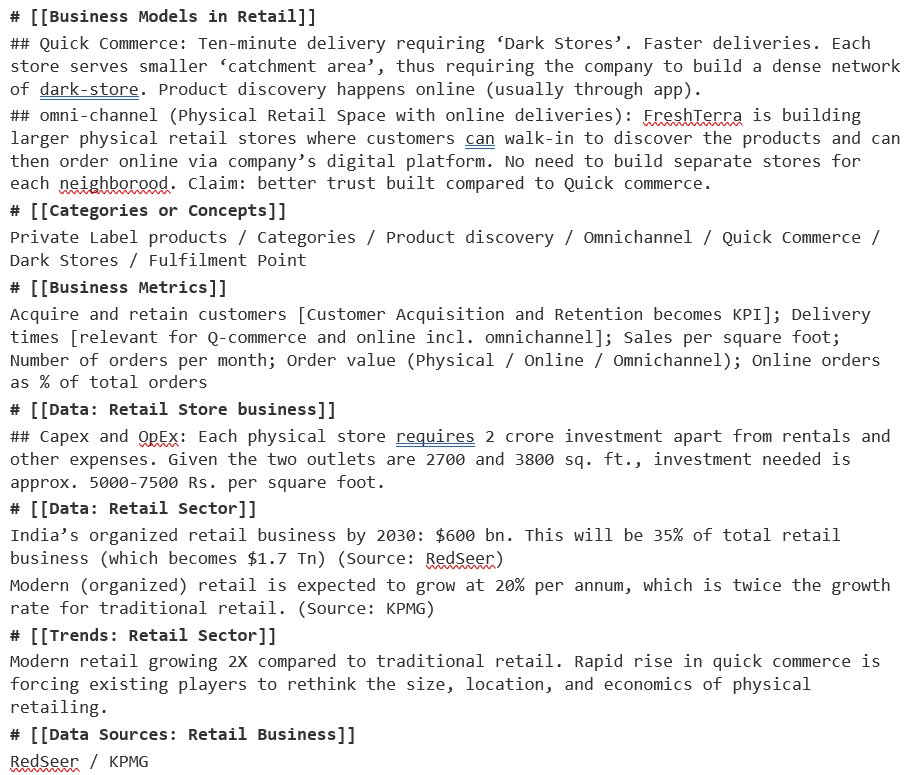
These notes do not sit idle. When the same student meets another retail business in the news a few months later, or when Uniqlo, Zepto or V2 Retail come to campus for recruitment, or when a consulting case study turns out to be about retail, the notes are already there. Six months from now I can come back to this clipping, look up what FreshTerra actually did against this plan, and correct my numbers against what happened.
Most students finish seventeen years of schooling with grade sheets and no system for holding what they learn. The MBA is when you close that gap. Build your own Personal Knowledge Management System, and start this week. Pick up an old newspaper, and read one article in it as closely as if you were going to be asked about the sector a year from now.